Ray Taylor (Attorney and forensic pathology expert):
"In the United States we take science as gospel. The public perception is that faking science is rare. The truth is it happens all the time." (
Source)
("F...B...I...", Did I spell that right?)
Michael Tonry (Professor of criminal law and public policy at the
University of Minnesota and former President of the American Society of
Criminology):
"These [most dangerous city type] rankings represent an irresponsible misuse of the [relevant crime] data and do groundless harm to many communities. They also work against a key goal of our society, which is a better understanding of crime-related issues by both scientists and the public." (
Source)
The FBI says: "The numbers are
in!" for its so-called "
Uniform Crime Report". And with this report, and the supposedly foundational numbers, come the annual "Most Dangerous City" rankings (For example, as reported
here and
here and
here). But how useful are they, really? (Perhaps more importantly, to
whom are they useful? More on
that in a moment.)
(
Source; St. Louis apparently came in at
number 2 or
number 3, depending upon which list one consults. Interestingly, the present day city of St. Louis sits atop the buried or obliterated remains of the ancient "
Mound City" complex which today is - with few exceptions - largely confined to Cahokia, IL. See
here and
here.
National Geographic states that the complex displays "...clear evidence of
ritual human sacrifice. Archaeologists excavating Mound 72, as they labeled it, found the remains of 53 women and one very high status man, as well as the decapitated remains of four men who may have been on the wrong side of some sort of authority...". St. Louis, with its signature "Gateway Arch" is known as "the gateway to the West." In Egyptian
myth, the land of the dead was sometimes called "the west".)
To begin with, some city leaders are "questioning the FBI numbers" themselves. Several municipalities are alleging that the FBI's number "paint a grossly inaccurate picture" of their respective cities. So there is some reason to think that some of the statistics are at least possibly unjustifiably high. (
Source)
Other statistics are plausibly susceptible to an "equal but opposite" (so to speak) error, namely, being artificially or deceptively low. Consider assault. At least women's advocacy group suggests: "The numbers barely scratch the surface, because many assaults go unreported...". (
Source)
Besides allegations of (sometimes ostensibly unaccountably) inaccurate data, the notion that the FBI's crime reporting is "uniform" has also been questioned. To illustrate, "...one police department may identify a crime as a burglary, while another may classify it as petty theft or mischief". (
Source)
Or again, some worry that, taking rape as an example: "...the FBI statistics at that time counted only forcible rape, not other attacks such as date rape or sexual crimes against children." (
Source)
To be sure, the FBI has claimed that it's so-called "NATIONAL INCIDENT-BASED REPORTING SYSTEM (NIBRS)" at least sometimes ignores (what we might call) parochial classifications, and claims to be aimed at raw "incident" reports. (
Source)
However, first, the FBI is on record admitting that significant inter-city difference do indeed exist. "Critics also complain that numbers don't tell the whole story because of differences among cities. 'You're not comparing apples and oranges;
you're comparing watermelons and grapes,'
said Rob Casey, who heads the FBI section that puts out the Uniform Crime Report that provides the data for the Quitno report." (Source: DAVID N. GOODMAN,
Associated Press, Wire Report, 19 November 2007, Original url:
http://news.yahoo.com/s/ap/20071119/ap_on_re_us/dangerous_cities)
(Come on! What's there not trust about the FBI?)
Second, as some municipal officials are quick to respond, "...
there [is] no verification or audit from the FBI...". It appears, therefore, that there is neither specific oversight (from the bottom-up, municipal to federal direction) nor a statistical "appeals" process. (
Source)
I consider it especially noteworthy that the FBI itself has warned against the construction of rankings of any sort and, indeed, the FBI itself declines to produce any ranking of its own data. A relevant press release reads as follows.
"Caution against ranking: Each year when Crime in the United States is published, some entities use the figures to compile rankings of cities and counties. These rough rankings provide no insight into the numerous variables that mold crime in a particular town, city, county, state, tribal area, or region. Consequently, they lead to simplistic and/or incomplete analyses that often create misleading perceptions adversely affecting communities and their residents. Valid assessments are possible only with careful study and analysis of the range of unique conditions affecting each local law enforcement jurisdiction. The data user is, therefore, cautioned against comparing statistical data of individual reporting units from cities, metropolitan areas, states, or colleges or universities solely on the basis of their population coverage or student enrollment." (
Source)
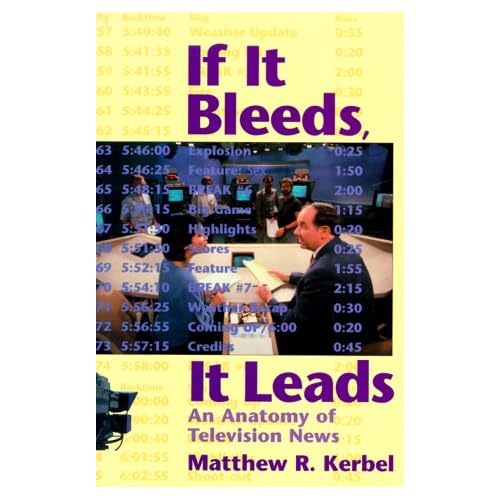
In the face of the popular perception of the "if it bleeds, it leads" media's over-eagerness to sensationalize reporting (plausibly in order to drive up ratings), the FBI's warning strikes me as about as psychologically useless as a jury's instruction "to disregard damaging testimony that is stricken from the record" when said testimony can scarcely be stricken "from their minds" (Cf.
Here)
Even putting aside the questionable the effectiveness of the FBI's "page six" "caveat lector" (compared with the "page one" "most dangerous cities" rankings), there are more serious worries. I will mention only two.
Number one, in previous years, supposedly uncorrectable and un-specifiable computer "glitches" skewed numbers. But, in light of the facts that there is no appeals process and that the psychological impressions made by the rankings can hardly be easily reversed once they have been left by a suitably sensationalized "news" report, one might be forgiven for wondering just how widespread such "glitches" are. (
Source)
As a parenthesis, I note that a similar constellation of issues is recognizable in computerized voting and the possibility of "black box" fraud. For, in "crime statistics" or in vote counting: "...a computer will only do what it's programmers and administrators tell it to do, whoever issues the commands gains ultimate control over how it receives, counts, and reports..." information. (See
HERE)
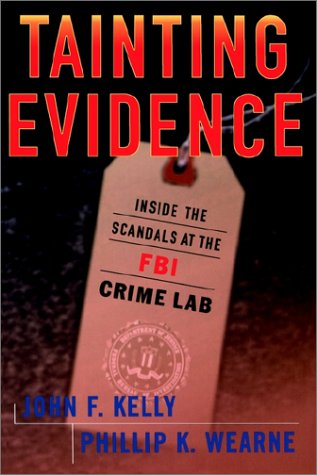
Number two, frankly, the FBI's record for accuracy is not exactly stellar (to put it diplomatically - which is probably more tact than is deserved).
"They said the guy's on the brink of a confession and they want me to
fabricate a fingerprint report." (Quotation
Source; Photo
Source)
What's the big deal? Rankings are just rankings, right? Some are concerned, however, about the potential negative psychological impact that the "most dangerous city rankings" may have on a community - both in terms of that community's morale and in terms of potential tourism.
(The real "crime scene" is sometimes arguably the front page of a newspaper; photo
source)
"'What I take exception to is the use of these statistics and
the damage they inflict on a number of these cities,' said [ex Rochester, NY] Mayor Robert Duffy..." (
Source)
And, tourism may not be the only area experiencing negative fallout from a bad "ranking". Speculatively, one might have reason to worry about such things as insurance company premiums and state and federal budget allotments. And all of this is, at least possibly, based on the precarious (at best) and unconscionable (at worst) manipulation of data, by way of arguably highly contrived and artificial "rankings" - a use of that data that the data collection organization itself (namely, the FBI) expressly (if weakly) warns against. When one considers also the potential for - and history of - error and fraud, I think that the "most dangerous cities rankings" might be better viewed as hardly more illuminating than similarly sensationalistic (if not fraudulent) lists such as of the "biggest party colleges" or the "best movies of the year". In other words, such lists arguably generate more heat than light. But in the present case, what is perhaps most palpable is the generated
fear.
Recall that I opened by posing the question: How *useful* are the numbers? Taking (or, at least, trying to take) on board all of the worries, suspicions, and criticisms, one might think that, after all, the numbers are indeed extremely useful. They generate fear.
Cui bono?
Noam Chomsky (
Source):
"So the fear of drugs and the fear of crime is very much stimulated by state and business propaganda. The National Justice Commission repeatedly points out that crime in the United States, while sort of high, is not off the spectrum for industrialized societies. On the other hand, fear of crime is far beyond other societies, and mostly stimulated by various propaganda."
For more information, see:
http://www.nytimes.com/books/first/k/kelly-evidence.html
http://www.amazon.com/Tainting-Evidence-Inside-Scandals-Crime/dp/0743236416